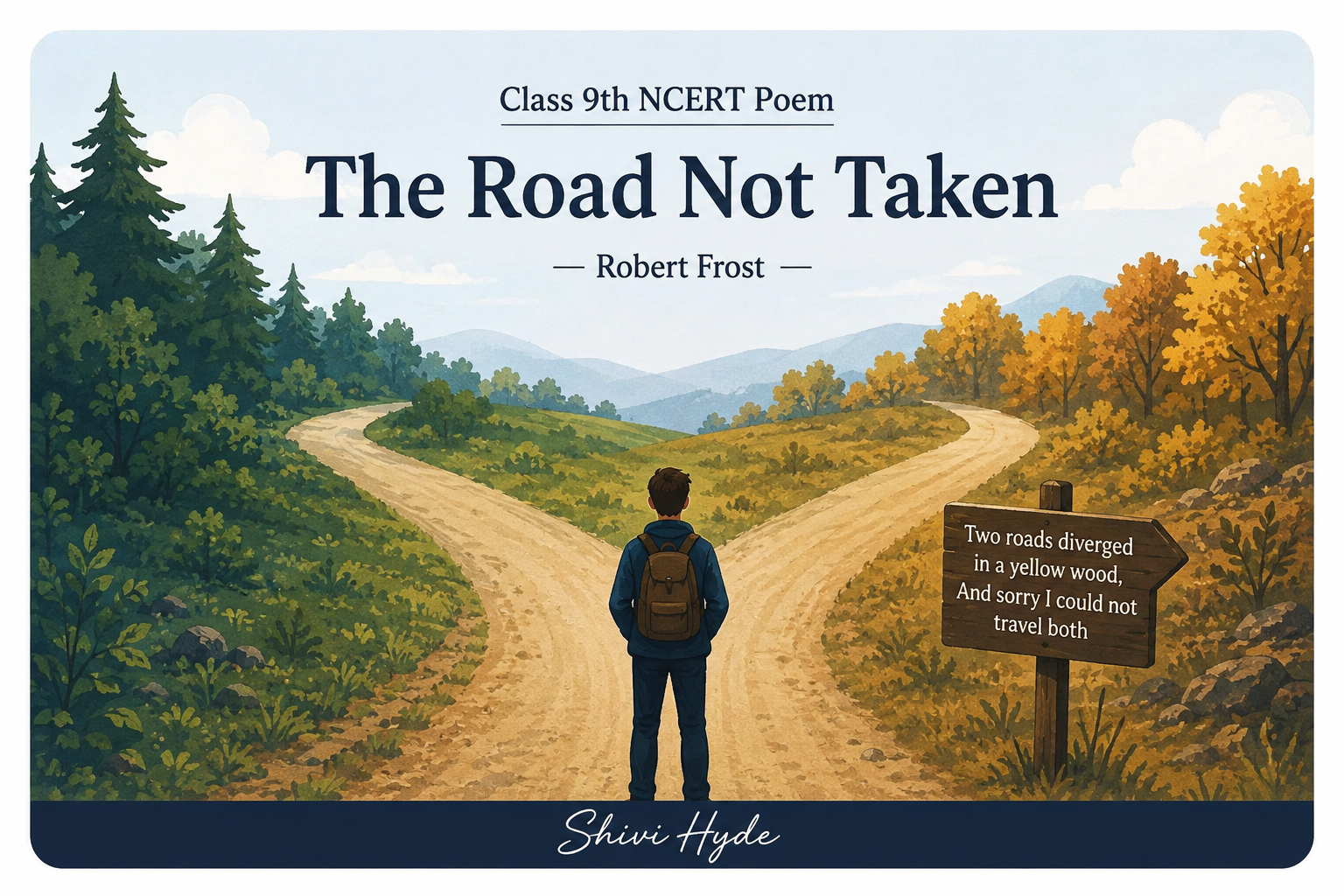
The Road Not Taken is one of the most famous poems by Robert Frost and is included in the Class 9 English syllabus. The poem is simple to read but carries a deep and meaningful message about choices, decisions, and the direction our lives take. Through the image of two roads diverging in a forest, the poet explains a situation that every person faces at some point in life—the need to choose between different options.
The poem teaches students that life is full of choices. Sometimes, we cannot follow every path available to us, and we must choose one direction while leaving another behind. The decision we make can influence our future in ways we may not fully understand at the time.
About the Poet Robert Frost
Robert Frost was a well-known American poet whose poetry often focused on nature, rural life, and human emotions. Although his poems frequently use simple images from nature, they usually contain deeper meanings related to life and human experiences.
In The Road Not Taken, Frost uses the image of a traveller standing in a yellow wood and looking at two different roads. This ordinary scene becomes a powerful symbol of the choices people make throughout their lives.
The Road Not Taken Summary
The poem begins with the speaker standing in a yellow wood, where two roads diverge in different directions. The traveller feels sorry because he cannot travel on both roads. Since he is only one person, he must choose one path and leave the other behind.
The speaker carefully looks down one of the roads as far as he can. However, the road eventually bends and disappears among the trees. He cannot see where it leads or what lies ahead.
After examining the first road, the traveller decides to take the other road. At first, he believes that this road appears slightly better because it looks grassy and seems to have been travelled less. However, he soon realizes that both roads have actually been used almost equally.
This part of the poem is important because it shows the uncertainty involved in making decisions. Often, when we make a choice, we may believe that one option is completely different or better than another. However, we cannot always know whether our decision is truly better until we have travelled further along that path.
The speaker also notices that both roads are covered with fresh leaves that morning. No one has stepped on them and turned them black. He tells himself that he will keep the first road for another day.
However, deep inside, he knows that he will probably never return. One decision leads to another, and life moves forward continuously. Once we choose a particular direction, it can become difficult or impossible to go back and experience the alternatives we left behind.
In the final stanza, the speaker imagines himself many years in the future. He says that he will tell the story of his choice with a sigh. He will say that two roads diverged in a wood, and he chose the one that was less travelled. According to him, this choice made all the difference in his life.
Meaning of the Two Roads in the Poem
The two roads in The Road Not Taken are not simply paths in a forest. They represent the choices and opportunities that people face in life.
Every individual reaches moments where an important decision must be made. A student may have to choose a career, a person may need to decide where to live, or someone may have to choose between two opportunities. At such moments, we often wish that we could choose both options and see where each one leads. Unfortunately, life does not always allow us to do that.
Just like the traveller in the poem, we must choose one path and leave another behind.
The roads also represent the uncertainty of life. When we make an important decision, we usually do not know what the future will look like. We can think carefully and make the best decision possible, but we cannot see the entire journey ahead of us.
Theme of The Road Not Taken
The central theme of The Road Not Taken is choice and its consequences. The poem shows that every decision can influence our future.
Another important theme is individuality. The speaker chooses a path that he believes is different, suggesting the importance of making personal decisions rather than simply following what everyone else does.
The poem also explores the theme of uncertainty and regret. The traveller does not know whether the road he has chosen will be better than the one he leaves behind. His mention of telling the story with a “sigh” can suggest different emotions. It may represent satisfaction, regret, nostalgia, or simply the deep feeling of remembering an important moment in life.
This ambiguity makes the poem more realistic because people often look back at important decisions and wonder what might have happened if they had chosen differently.
Explanation of the Yellow Wood
The yellow wood creates the setting of the poem. Yellow leaves suggest the autumn season, a time when nature is changing. This can also symbolically represent a period of change in the speaker’s life.
The traveller is standing at a point where two roads separate, which represents a turning point. He must decide which direction to take.
The forest also makes it impossible for the traveller to see the final destination of either road. In the same way, human beings cannot completely predict the consequences of their choices.
Why Could the Traveller Not Return?
The speaker says that he will keep the first road for another day, but he knows that he may never come back.
This reflects an important truth about life. One decision often leads to another. Once we move forward in a particular direction, new experiences and responsibilities appear. As a result, returning to the exact point where we made the original choice may not be possible.
For example, a student who chooses a particular subject may later follow a career connected to that decision. Over time, life moves forward, and the other options become part of the past.
Therefore, the poem reminds us that our choices can shape the journey of our lives.
What Does “That Has Made All the Difference” Mean?
The final line of the poem is one of its most memorable lines:
“And that has made all the difference.”
This line means that the choice made by the traveller had an important effect on his life. However, Robert Frost does not clearly explain whether the difference was positive or negative.
This is one of the most interesting aspects of the poem. The speaker is looking back on his decision after many years, but he cannot know exactly what would have happened if he had taken the other road.
The line reminds readers that every choice creates a different future. Even a small decision can sometimes lead to major changes over time.
Important Message of The Road Not Taken
The poem gives a valuable message to students and readers of all ages. Life is full of choices, and no one can experience every possible path. At different stages of life, we must make decisions and move forward.
The poem encourages us to think carefully before making important choices. At the same time, it teaches us that uncertainty is a natural part of life. We cannot always know whether a decision is perfect.
Instead of remaining stuck between different options forever, we must eventually choose a path and continue our journey.
The poem also teaches us to take responsibility for our choices. Once a decision is made, it becomes part of our personal journey and helps shape who we become.
Literary Devices Used in The Road Not Taken
Robert Frost uses several literary devices to make the poem meaningful and memorable.
Symbolism
The two roads symbolize the different choices available in life. The journey represents the journey of life itself.
Metaphor
The roads can be understood as a metaphor for important life decisions.
Imagery
The poet creates a clear picture of a traveller standing in a yellow forest and looking at two diverging roads.
Rhyme Scheme
The poem follows a regular rhyme scheme that gives it a smooth and musical flow.
Personification
The road is described as having “wanted wear,” giving it a quality that helps readers imagine the path as something with its own character.
Conclusion
The Road Not Taken is much more than a poem about a traveller choosing between two paths in a forest. It is a thoughtful poem about the decisions we make and the uncertainty that comes with them.
Robert Frost beautifully uses the image of two roads to represent the many choices that people face throughout life. The speaker cannot travel both paths, just as we cannot experience every possible future. He must choose one road and continue moving forward.
The poem reminds us that choices are an unavoidable part of life. We may sometimes wonder about the opportunities we leave behind, but we must still make decisions and accept the journey that follows.
For Class 9 students, The Road Not Taken offers an important lesson: think carefully, make your choice, and move forward with confidence because every decision becomes a part of your unique journey.
Frequently Asked Questions (FAQs)
1. What is the summary of The Road Not Taken?
The Road Not Taken is about a traveller who comes across two roads in a forest and must choose one because he cannot travel both. The roads symbolize the choices people make in life.
2. What is the main theme of The Road Not Taken?
The main theme of the poem is choice and its consequences. It explains how the decisions we make can influence the direction of our lives.
3. What do the two roads symbolize?
The two roads symbolize different choices, opportunities, and paths available to a person in life.
4. Why does the traveller feel sorry?
The traveller feels sorry because he cannot travel on both roads. He must choose one path and leave the other unexplored.
5. What is the message of The Road Not Taken?
The poem teaches us that life requires us to make choices. Although we cannot always predict the results of our decisions, we must choose a direction and move forward.
Read More: How I Taught My Grandmother to Read