How I Taught My Grandmother to Read is one of the most heartwarming and inspiring stories included in the CBSE Class 9 English curriculum. Written by the well-known Indian author and philanthropist Sudha Murty, the story beautifully highlights the importance of education, determination, independence, and the relationship between a grandmother and her granddaughter.
The story carries a powerful message that remains relevant for people of all ages: it is never too late to learn. Through the journey of an elderly grandmother who decides to learn reading and writing, readers understand how education can bring confidence, freedom, and self-respect.
For CBSE Class 9 students, this chapter is not only important from an examination point of view but also offers valuable life lessons that can be applied beyond the classroom.
Introduction to How I Taught My Grandmother to Read
The story is narrated by Sudha Murty and is based on a personal experience from her childhood. It revolves around the close relationship between the narrator and her grandmother.
The grandmother is an affectionate and curious woman who has never had the opportunity to receive formal education. Like many women of her generation, she could not read or write. However, she loved listening to stories and was always interested in knowing what was happening around her.
Every week, the grandmother eagerly waited for a Kannada magazine called Karmaveera. The magazine published a popular serial story titled Kashi Yatre. The grandmother was deeply interested in this story and depended on her granddaughter to read each new episode aloud.
Reading the story together became a special routine for both of them. The grandmother eagerly listened to every chapter and waited for the next issue to discover what would happen to the characters.
However, one incident completely changed the grandmother’s life and inspired her to begin her own journey of education.
The Story of Kashi Yatre
Kashi Yatre was a popular Kannada serial that the grandmother loved listening to. The story was written by Triveni and followed the journey of an elderly woman who wished to visit Kashi.
The main character of the serial wanted to go on a pilgrimage to Kashi because she believed it would bring peace and spiritual fulfilment. However, during her journey, she came across a young orphan girl who needed financial help to get married.
The elderly woman faced a difficult decision. She could either continue her journey to fulfil her own dream or use her savings to help the young girl.
The grandmother was deeply interested in the story because she admired the emotions, sacrifices, and values presented in it. She eagerly waited every week for the narrator to read the latest episode.
Her strong attachment to Kashi Yatre later became the reason she realized how important it was to become literate.
The Incident That Changed Everything
One day, the narrator had to go to a nearby village to attend a wedding. She stayed there for a few days and was unable to return home immediately.
During her absence, the latest issue of Karmaveera arrived. The grandmother was excited to read the new episode of Kashi Yatre. However, she suddenly faced a problem that she could not solve.
She could not read.
For years, she had depended on her granddaughter or other people whenever she wanted to read something. But this time, the person she depended on was not at home.
The grandmother looked at the magazine and wished desperately that she could read the words herself. She tried to find someone who could help her, but the experience made her feel helpless and dependent.
When the granddaughter returned home, she saw her grandmother sitting near the magazine. The grandmother was emotional and disappointed because she had been unable to read the latest episode of her favourite story.
This experience made the grandmother realize that illiteracy was limiting her independence.
At that moment, she made a strong decision that changed her life.
The Grandmother Decides to Learn
The grandmother tells her granddaughter that she no longer wants to depend on others for reading. She wants to become independent and asks the narrator to teach her how to read and write.
This request is especially meaningful because the grandmother does not allow her age to become an excuse.
Learning a new skill as an elderly person can be challenging. She had never attended school and was beginning from the basics. However, she had something more powerful than experience: determination.
The grandmother set a clear goal for herself. She wanted to learn to read before the festival of Dussehra.
This deadline gave her motivation and encouraged her to practise regularly.
Her decision is one of the strongest moments in the story. Instead of feeling embarrassed about not being educated, she openly accepts her weakness and decides to improve herself.
This is a lesson that people of every age can learn from.
When the Granddaughter Becomes the Teacher
The roles between the grandmother and granddaughter are beautifully reversed in this story.
Normally, grandparents are considered teachers who share their experiences and wisdom with younger generations. However, in How I Taught My Grandmother to Read, the young granddaughter becomes the teacher.
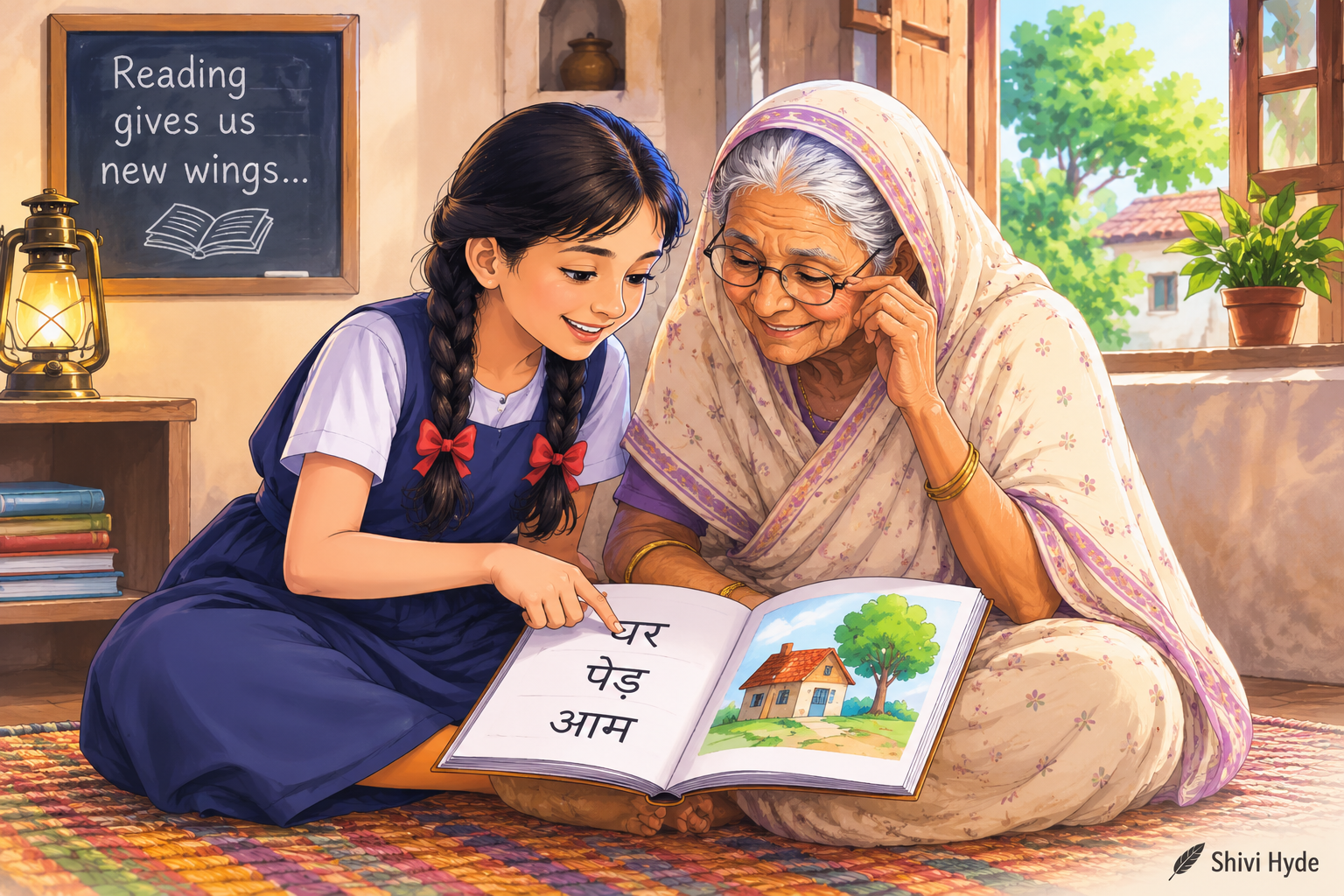
The narrator takes her responsibility seriously and begins teaching her grandmother the Kannada alphabet.
The grandmother becomes a sincere and hardworking student. She listens carefully, practises regularly, and tries to remember everything she learns.
The learning process is not easy. Reading and writing require patience, concentration, and repetition. However, the grandmother refuses to give up.
This relationship between teacher and student is one of the most beautiful aspects of the story. The narrator teaches her grandmother literacy, while the grandmother teaches the narrator and readers the value of determination.
Together, they prove that teaching and learning can happen between people of any age.
The Importance of Determination
The grandmother’s determination is the central message of the story.
Many people stop themselves from learning something new because they believe they are too old, too inexperienced, or too late to begin. The grandmother challenges this way of thinking.
She does not say that learning will be easy. She does not expect immediate success. Instead, she works patiently towards her goal.
She practises every day and continues moving forward, one step at a time.
Her story teaches us that success often depends more on consistency than on age or natural ability.
The grandmother also understands the importance of having a goal. By deciding that she would learn before Dussehra, she gives herself a deadline.
This teaches students an important lesson about goal-setting. A clear goal can provide direction and motivation.
The Special Dussehra Day
Dussehra becomes an unforgettable day for both the grandmother and the granddaughter.
The grandmother had promised herself that she would learn to read before the festival. Through regular practice and determination, she successfully achieves her goal.
On Dussehra, she is finally able to read independently.
The granddaughter gives her grandmother a copy of Kashi Yatre, the story that had inspired her journey towards literacy.
The grandmother reads the first page on her own.
This is an emotional and proud moment. What once made her feel helpless has now become a symbol of her independence.
The grandmother has achieved something much bigger than simply learning the alphabet. She has gained confidence in herself.
Her success proves that determination can help people overcome challenges that may initially seem impossible.
Why Does the Grandmother Touch Her Granddaughter’s Feet?
One of the most touching moments in How I Taught My Grandmother to Read occurs when the grandmother touches the feet of her young granddaughter.
The narrator is surprised and uncomfortable because her grandmother is much older than she is. In Indian culture, younger people usually touch the feet of elders to show respect.
However, the grandmother explains that age does not matter when it comes to education and teaching.
According to her, the person who gives knowledge deserves respect, regardless of their age.
This moment highlights the importance of the traditional Indian belief that a teacher deserves deep respect.
The grandmother does not see her granddaughter simply as a child. She sees her as her teacher.
This scene teaches readers that knowledge is greater than age, and a true teacher deserves respect regardless of who they are.
Major Themes in How I Taught My Grandmother to Read
Education Gives Independence
The most important theme of the story is the power of education.
Before learning to read, the grandmother depended on others whenever she wanted to understand written information. After becoming literate, she gained independence.
She no longer had to wait for someone else to read a magazine or story to her.
This shows how education gives people freedom and confidence.
It Is Never Too Late to Learn
The grandmother proves that learning has no age limit.
Even though she is old and has never attended school, she successfully learns to read.
Her story encourages people to continue learning throughout their lives.
Determination Brings Success
The grandmother succeeds because she is determined.
She sets a goal, practises regularly, and refuses to give up when learning becomes difficult.
Her journey shows that consistent effort can help people achieve meaningful goals.
Respect for Teachers
The story also teaches the importance of respecting teachers.
The grandmother’s gesture of touching her granddaughter’s feet shows her deep respect for the person who gave her the gift of literacy.
It reminds us that teachers can be younger or older than their students.
The Bond Between Grandmother and Granddaughter
The relationship between the two characters is full of love, trust, and respect.
Their bond becomes even stronger through the process of teaching and learning.
The story beautifully shows how family members can help each other grow.
Important Life Lessons for Students
Students can learn many valuable lessons from How I Taught My Grandmother to Read.
First, education should never be taken for granted. The ability to read and write is something that gives people independence and confidence.
Second, students learn the importance of helping others. The granddaughter does not hesitate to teach her grandmother.
Third, the story encourages students to remain determined. Challenges may make learning difficult, but regular effort can lead to success.
Finally, the chapter teaches readers to respect knowledge and teachers.
The grandmother’s journey reminds students that education is not limited to classrooms, schools, or examinations. Learning can happen anywhere and at any stage of life.
Conclusion
How I Taught My Grandmother to Read is a beautiful and meaningful story about literacy, determination, independence, and the lifelong value of education.
The grandmother begins her journey feeling dependent because she cannot read her favourite story without help. However, instead of accepting this limitation, she decides to change her life.
With the support of her granddaughter and her own determination, she learns to read and achieves the goal she sets for herself.
Her journey delivers a powerful message: no one is ever too old to learn something new.
The story also reminds us that education is much more than passing exams. It gives people independence, confidence, and the ability to make their own choices.
For CBSE Class 9 students, this chapter is an inspiring example of how determination and regular effort can help people overcome limitations. The grandmother may have learned to read from her granddaughter, but through her courage and determination, she teaches all readers one of life’s greatest lessons—the desire to learn can change a person’s life at any age.
FAQs About How I Taught My Grandmother to Read
1. Who wrote How I Taught My Grandmother to Read?
How I Taught My Grandmother to Read was written by Sudha Murty. The story is based on a personal experience from her childhood and highlights the importance of education and lifelong learning.
2. Why did the grandmother want to learn to read?
The grandmother wanted to learn to read because she felt helpless when her granddaughter was away and she could not read the latest episode of Kashi Yatre. She realized that she did not want to depend on others for reading.
3. What inspired the grandmother to become literate?
The grandmother’s inability to read her favourite story, Kashi Yatre, inspired her to become literate. She wanted to become independent and be able to read stories by herself.
4. What is the main message of How I Taught My Grandmother to Read?
The main message of the story is that it is never too late to learn. With determination, regular practice, and the right guidance, people can learn new skills at any stage of life.
5. Why did the grandmother touch her granddaughter’s feet?
The grandmother touched her granddaughter’s feet to show respect to her teacher. She believed that the person who gives knowledge deserves respect, regardless of their age.
6. What did the grandmother achieve by Dussehra?
By Dussehra, the grandmother successfully learned how to read. She was able to read the first page of Kashi Yatre independently, achieving the goal she had set for herself.
7. What can students learn from How I Taught My Grandmother to Read?
Students can learn the importance of education, determination, independence, regular practice, helping others, and respecting teachers. The story also teaches that age should never become a barrier to learning.